

Blog
Halal vs Kosher: What Is the Difference?

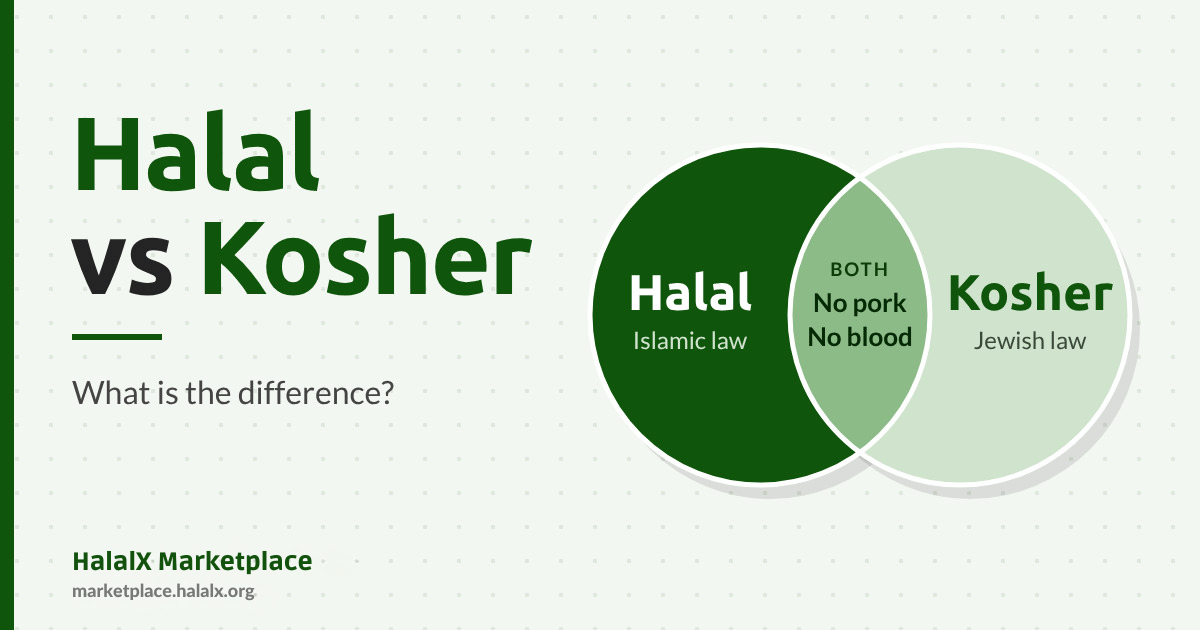
Quick answerHalal vs kosher: are they the same? No. Halal follows Islamic law and kosher follows Jewish law. They share some rules, such as avoiding pork and blood, but they differ on slaughter, alcohol, and mixing meat with dairy. So kosher food is not automatically halal.[1]
Halal and kosher are often mentioned together, and many shoppers in the USA see both symbols on the same shelf. This halal vs kosher guide compares the two side by side, explains what they have in common, and answers the question many Muslims ask: can I eat kosher food? In addition, every rule below links to its source.
What is halal?
Halal means “lawful or permitted” in Arabic. It covers permissible food and drink as well as daily life practices, and its rules come from the Quran and Sunnah.[1] The Quran tells believers:
“O mankind! Partake of what is lawful and good on earth, and follow not Satan’s footsteps…”
Quran 2:168
For a full explanation, read our guide: What is halal?
What is kosher?
Kosher is a Hebrew word meaning “fit” or “proper” under Jewish dietary law. According to OU Kosher, the kosher certification program of the Orthodox Union, the basic laws come from the Torah, and rabbinic scholars have interpreted them for thousands of years.[2]
Kosher food falls into three groups: meat, dairy, and pareve. Also, OU Kosher defines pareve as food that contains no dairy or meat ingredients and was not processed with heat on dairy or meat equipment.[2]
Halal vs kosher side by side
The biggest differences in halal vs kosher are slaughter, alcohol, and meat with dairy. The table compares the main rules, each with its source.
| Topic | Halal | Kosher |
|---|---|---|
| Religious source | Quran and Sunnah[1] | Torah, interpreted by rabbinic scholars[2] |
| Pork | Forbidden (Quran 2:173)[3] | Forbidden[4] |
| Blood | Forbidden (Quran 2:173)[3] | Forbidden. Blood is removed from meat by salting or broiling.[2] |
| Slaughter | God’s name must be pronounced (Quran 6:121)[5] | Shechita by a trained kosher slaughterer (shochet). Saying God’s name is not required.[2][1] |
| Alcohol | Every intoxicant is forbidden (Sahih Muslim 2003a)[6] | Wine and grape products are allowed when made under rabbinic supervision[2] |
| Meat with dairy | No such restriction[1] | Forbidden. Separate dishes and utensils are required.[2] |
| Seafood | “What dies in it is lawful food” (Sunan Abi Dawud 83).[7] Views on shellfish vary by school of thought.[1] | Only fish with fins and scales. All shellfish are prohibited.[2] |
| Label to look for | A halal certification symbol[1] | Kosher symbols such as OU, K or KOF-K[1] |
Slaughter: the key difference
In Islam, the name of God must be pronounced over the animal. The Quran says:
“Hence, eat not of that over which God’s name has not been pronounced: for this would be sinful conduct indeed.”
Quran 6:121
A trained kosher slaughterer (shochet) must carry out kosher slaughter, called shechita. Afterwards, an inspector checks the organs, and the blood is removed by salting or broiling.[2] The American Halal Foundation notes that kosher slaughter does not require saying God’s name, which halal slaughter does.[1]
Alcohol: allowed in kosher, forbidden in halal
Kosher law permits wine and grape products made under strict rabbinic supervision.[2] However, in Islam, the Prophet ﷺ said: “Every intoxicant is Khamr and every intoxicant is forbidden.”[6] So kosher wine is never halal.[1]
Meat and dairy: a kosher rule only
Kosher law forbids cooking or eating meat and milk together, and many people wait several hours after meat before eating dairy.[2] Halal has no such rule, so a halal cheeseburger is fine if every ingredient is halal.[1]
What halal and kosher have in common
Both forbid pork and blood, and both care about cross-contamination. For example, under kosher law, food made on equipment used for non-kosher products can become non-kosher.[4] Similarly, under halal rules, halal food touched by utensils used for haram food becomes haram.[1]
Many simple foods can be both halal and kosher, according to the American Halal Foundation:[1]
- Fresh fruits and vegetables, free from insects
- Grains and legumes such as rice, oats, lentils, beans and chickpeas, if not cross-contaminated
- 100% fruit juice and bottled water
- Some dairy, if it has no animal enzymes or gelatin from non-halal sources
- Fish such as salmon, tuna and cod
Is kosher halal? Can Muslims eat kosher food?
Kosher is not automatically halal.[1] This is the question Muslims ask most.
However, some point to this verse about the People of the Book:
“And the food of those who have been vouchsafed revelation aforetime is lawful to you, and your food is lawful to them.”
Quran 5:5
The American Halal Foundation explains that some scholars permit kosher meat under specific conditions, while others do not accept this view. Its own position is that Muslims should not casually assume kosher meat and products are halal, and that the safest approach is halal-certified meat.[1]
Even so, scholars who accept kosher meat cannot accept every kosher product. Kosher wine, and food cooked with alcohol, is still forbidden for Muslims.[1][6] For a ruling that applies to you, ask a qualified scholar you trust.
Is halal kosher? Can Jewish people eat halal food?
Halal meat is not kosher. OU Kosher states that only a trained kosher slaughterer is qualified to slaughter an animal for kosher consumption, and that kosher meat must be supervised from slaughter until it reaches the consumer.[2] Halal meat does not go through this process. Kosher law also forbids things halal rules allow, such as eating meat with dairy.[1][2] Jewish readers with questions should ask their rabbi.
How to check if a product is halal, not just kosher
- 1First, look for a halal symbol. If there is no halal mark, the product has not been verified as halal.[1]
- 2Second, do not rely on a kosher symbol alone. OU, K and KOF-K mean the product follows Jewish law, not Islamic law.[1]
- 3Third, read the ingredients. Watch for gelatin, enzymes, alcohol in flavorings or extracts, and meat or broth.[1]
- 4Finally, ask the seller. If anything is unclear, contact the brand or seller before you buy.[1]
Common questions about halal vs kosher
What is the Islamic equivalent of kosher?
Halal. Kosher food follows Jewish law from the Torah, and halal food follows Islamic law from the Quran.[1] The two systems are similar in purpose but have different rules.
Is kosher stricter than halal?
They are strict in different ways. Kosher puts more weight on animal types and keeping meat and dairy apart, while halal puts more weight on purity and the slaughter method.[1]
Is kosher gelatin halal?
Not automatically. It may be suitable if it comes from kosher-slaughtered beef and has no contamination, but it needs to be verified.[1]
Are kosher restaurants halal-friendly?
Not always. They avoid pork, but they may serve meat that was not slaughtered the halal way, cook with alcohol, or share utensils with non-halal food.[1]
What does pareve mean on a kosher label?
Pareve means the food has no dairy or meat ingredients and was not processed with heat on dairy or meat equipment.[2] It does not mean the food is halal.
Shop halal with HalalX Marketplace
HalalX Marketplace brings together independent sellers of halal and Muslim-friendly products in one place.
Halal Food Halal Vitamins & Supplements Cosmetics & Personal CareSources
- American Halal Foundation, Is Kosher Halal: Can Muslims Eat Kosher? (updated October 21, 2026).
- OU Kosher (Orthodox Union), The Kosher Primer.
- Quran 2:173, IslamiCity.
- OU Kosher (Orthodox Union), What is Kosher Certification?
- Quran 6:121, IslamiCity.
- Sahih Muslim 2003a (Book 36, Hadith 92), IslamiCity Hadith.
- Sunan Abi Dawud 83 (Book 1, Hadith 83), IslamiCity Hadith.