
What is Halal ?

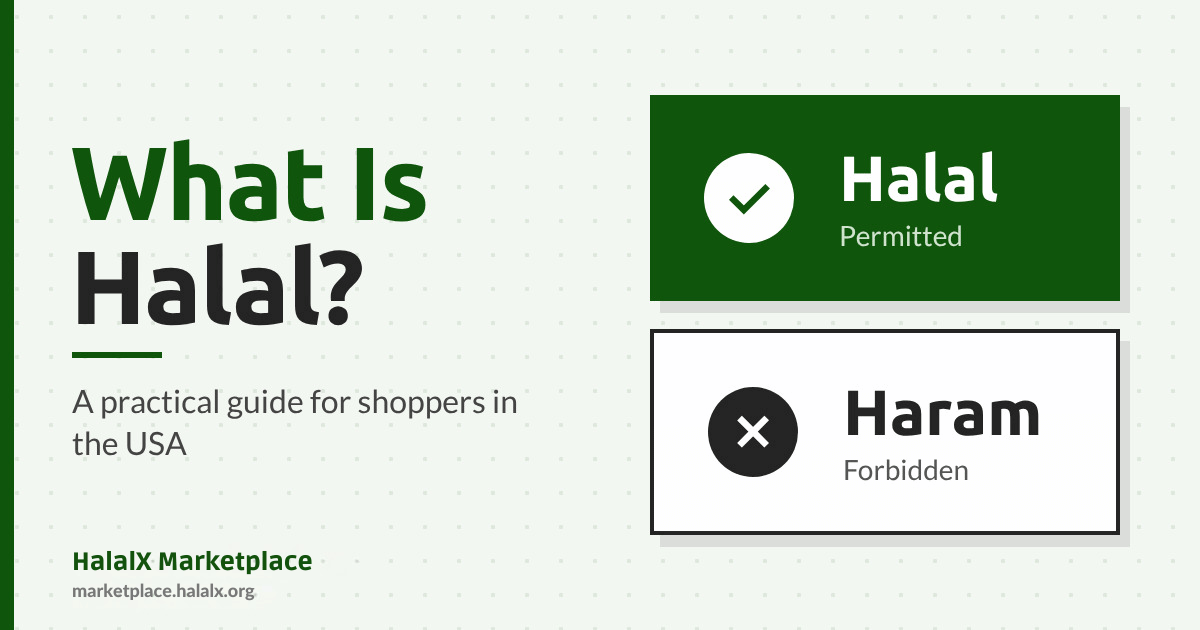
Quick answerWhat is halal? Halal is an Arabic word that means “permissible.” In Islam, it describes anything allowed under Islamic law, including food, drink and everyday products.[1] Its opposite is haram, meaning unlawful or forbidden.[5] The Quran tells believers to eat what is lawful and good.[2]
If you shop for food, supplements or beauty products as a Muslim in the USA, you will see the word “halal” on many labels. This guide answers the question “what is halal?” It also explains where the rules come from, what makes a product halal, and how to check a label. Every Quran verse and hadith below links to its source, so you can read it in full.
What is halal? The meaning of halal
Halal means “permissible” or “lawful.” The American Halal Foundation, a US halal certifier, defines it as an Arabic term meaning “permissible” that, for food and consumer products, refers to anything allowed under Islamic law.[1]
In fact, the word is not limited to meat or food. It describes what Muslims may eat, drink, use and earn. The rules come from two main sources: the Quran and the teachings of the Prophet Muhammad ﷺ, known as the Sunnah and recorded in hadith collections.
The Quran calls on all people to eat what is both lawful and good:
“O mankind! Partake of what is lawful and good on earth, and follow not Satan’s footsteps…”
Quran 2:168
Also, the same message appears in other verses, such as 5:88 (“Thus, partake of the lawful, good things which God grants you as sustenance…”)[3] and 16:114.[4]
Halal vs haram: what is the difference?
Halal is what Islam allows, and haram is what Islam forbids. The Prophet ﷺ taught that most things are clear, but some fall in between:
“Both legal and illegal things are evident but in between them there are doubtful (suspicious) things…”
Narrated by An-Nu’man bin Bashir, Sahih al-Bukhari 52 (also reported in Sahih Muslim 1599a)
The same hadith continues: “So whoever saves himself from these suspicious things saves his religion and his honor…”[5] In practice, this is why many Muslims check ingredient lists and avoid a product when they are unsure.
| Term | Meaning | Example from the sources |
|---|---|---|
| Halal | Permissible, lawful | “Today, all the good things of life have been made lawful to you.” (Quran 5:5)[6] |
| Haram | Unlawful, forbidden | Carrion, blood and swine (Quran 2:173)[7] |
| Doubtful | Not clear to many people | The “doubtful (suspicious) things” in Sahih al-Bukhari 52[5] |
What makes something halal?
A product is halal when it contains nothing forbidden and has not been contaminated by anything forbidden. The American Halal Foundation says a product qualifies as halal when it contains none of six prohibited categories, and it also lists cross-contamination on shared equipment as a concern.[1] The six categories it lists are:
- Alcohol and other intoxicants
- Meat that was not slaughtered in the proper way
- Blood
- Carnivorous animals
- Food offered to idols
- Swine (pork) and its derivatives
Also, these categories match what the Quran names. In Surah Al-Ma’idah, Allah says:
“Forbidden to you is carrion, and blood, and the flesh of swine, and that over which any name other than God’s has been invoked…”
Quran 5:3
On intoxicants, the Prophet ﷺ said: “Every intoxicant is Khamr and every intoxicant is forbidden…”[8] The Quran calls intoxicants “a loathsome evil of Satan’s doing” (5:90).[9]
However, Islamic scholars sometimes differ on details, such as particular ingredients. For a personal ruling, ask a qualified scholar you trust.
Many shoppers also ask how halal compares with kosher. Read our guide: Halal vs kosher.
What is halal food?
Halal food is food Muslims are allowed to eat under Islamic law. The Quran presents the forbidden list as short and specific:
“He has forbidden to you only carrion, and blood, and the flesh of swine, and that over which any name other than God’s has been invoked…”
Quran 2:173
In addition, the same verse adds that a person “driven by necessity – neither coveting it nor exceeding his immediate need” commits no sin.[7] Quran 6:145 makes a similar point: “I do not find anything forbidden to eat, if one wants to eat thereof, unless it be carrion, or blood poured forth, or the flesh of swine…”[10]
Foods to watch for
The US Department of Agriculture (USDA) gives this summary for its food programs: “Halal diets typically do not permit pork products, alcohol and products that contain alcohol…”[11] The USDA also notes that some cheese is made with rennet, an animal-derived ingredient, so that cheese “would not be acceptable to halal-observant communities.”[11]
Foods that are often halal without a certificate
According to the USDA, some products may be acceptable to halal-observant communities without halal certification. Its examples are fresh produce, certain fish and shell eggs.[11]
About food from the sea, the Prophet ﷺ said of the sea: “Its water is pure and what dies in it is lawful food.”[12] (Sunan Abi Dawud 83, graded sahih by Al-Albani.)
Meat and poultry
In contrast, meat needs more care than plant foods. The Quran forbids meat “over which any name other than God’s has been invoked” (2:173), and halal certifiers list improperly slaughtered meat as a prohibited category.[1] When buying meat, look for halal certification or ask the seller how it was slaughtered.
Halal is more than food
Halal applies to everything a Muslim consumes, uses and earns, not only to meals. A well-known hadith ties a person’s food, drink, clothing and nourishment to the acceptance of their prayers:
“O people, Allah is Good and He therefore, accepts only that which is good…”
Narrated by Abu Huraira, Sahih Muslim 1015
The same hadith describes a man whose “diet is unlawful, his drink is unlawful, and his clothes are unlawful and his nourishment is unlawful,” and asks: “How can then his supplication be accepted?”[13]
Supplements and vitamins
Similarly, check the ingredients the same way as food, especially anything that may come from swine or contain alcohol, two of the prohibited categories.[1] Shop halal vitamins and supplements
Cosmetics and personal care
Likewise, halal certifiers apply the halal rules to consumer products as well as food.[1] Browse halal cosmetics and personal care
Fragrances
For example, many shoppers check whether a perfume contains alcohol. Read the label, or ask the seller. Explore perfume oils and attars
Money and earnings
Halal also applies to how money is earned. The Quran says: “God has made buying and selling lawful and usury unlawful.”[14]
Halal certification and halal labels
A halal certificate means an outside organization has checked a product against halal rules. The USDA explains that some USDA Foods are certified halal, and it marks those items with “(H)” on its food list.[11] Certification is issued by halal certification organizations. The American Halal Institute, for example, has offered halal certification in the USA.[1]
How to check a product in 4 steps
- 1First, read the ingredient list. Look for anything from the prohibited categories above, such as pork derivatives, alcohol or animal-derived ingredients like rennet.
- 2Second, look for a halal mark. Check which organization issued it.
- 3Third, ask the seller. If a product says it is halal or halal-certified, you can ask for the certificate.
- 4Finally, when in doubt, leave it. This follows the hadith on doubtful things in Sahih al-Bukhari 52.[5]
Common questions about halal
What is halal in simple words?
Halal means “permissible.” In Islam, it describes what Muslims are allowed to eat, drink, use and earn.[1]
What makes something halal?
It must contain nothing from the prohibited categories, such as pork, blood, alcohol or improperly slaughtered meat, and must not be cross-contaminated with them.[1]
What is haram?
Haram means unlawful or forbidden. The Quran names carrion, blood, the flesh of swine, and that over which any name other than God’s has been invoked (2:173, 5:3), and intoxicants are also forbidden (Sahih Muslim 2003a).[7][8]
What does halal certified mean?
It means a halal certification organization has checked the product. The USDA, for example, marks its certified halal foods with “(H)” on its food list.[11]
Is halal only about food?
No. Sahih Muslim 1015 mentions food, drink, clothing and nourishment, and the Quran makes usury unlawful (2:275).[13][14]
Is seafood halal?
The Prophet ﷺ said of the sea: “Its water is pure and what dies in it is lawful food” (Sunan Abi Dawud 83).[12] Scholars discuss some details, so ask a qualified scholar if you are unsure about a specific item.
Shop halal with HalalX Marketplace
HalalX Marketplace brings together independent sellers of halal and Muslim-friendly products in one place.
Halal Food Halal Vitamins & Supplements Cosmetics & Personal CareSources
- American Halal Foundation, Halal Certification in the USA (definition of halal, six prohibited categories, cross-contamination).
- Quran 2:168 and 2:172, IslamiCity 2:168, IslamiCity 2:172.
- Quran 5:88, IslamiCity.
- Quran 16:114, IslamiCity.
- Sahih al-Bukhari 52 (Book 2, Hadith 45), IslamiCity Hadith; Sahih Muslim 1599a (Book 22, Hadith 133), IslamiCity Hadith.
- Quran 5:5, IslamiCity.
- Quran 2:173 and 5:3, IslamiCity 2:173, IslamiCity 5:3.
- Sahih Muslim 2003a (Book 36, Hadith 92), IslamiCity Hadith.
- Quran 5:90, IslamiCity.
- Quran 6:145, IslamiCity.
- USDA Food and Nutrition Service, Halal Foods in TEFAP (updated September 30, 2025).
- Sunan Abi Dawud 83 (Book 1, Hadith 83), IslamiCity Hadith. Graded sahih by Al-Albani, as listed on Sunnah.com.
- Sahih Muslim 1015 (Book 12, Hadith 83), IslamiCity Hadith.
- Quran 2:275, IslamiCity.