

Is Gelatin Halal? Pork, Beef, Fish & Kosher Explained

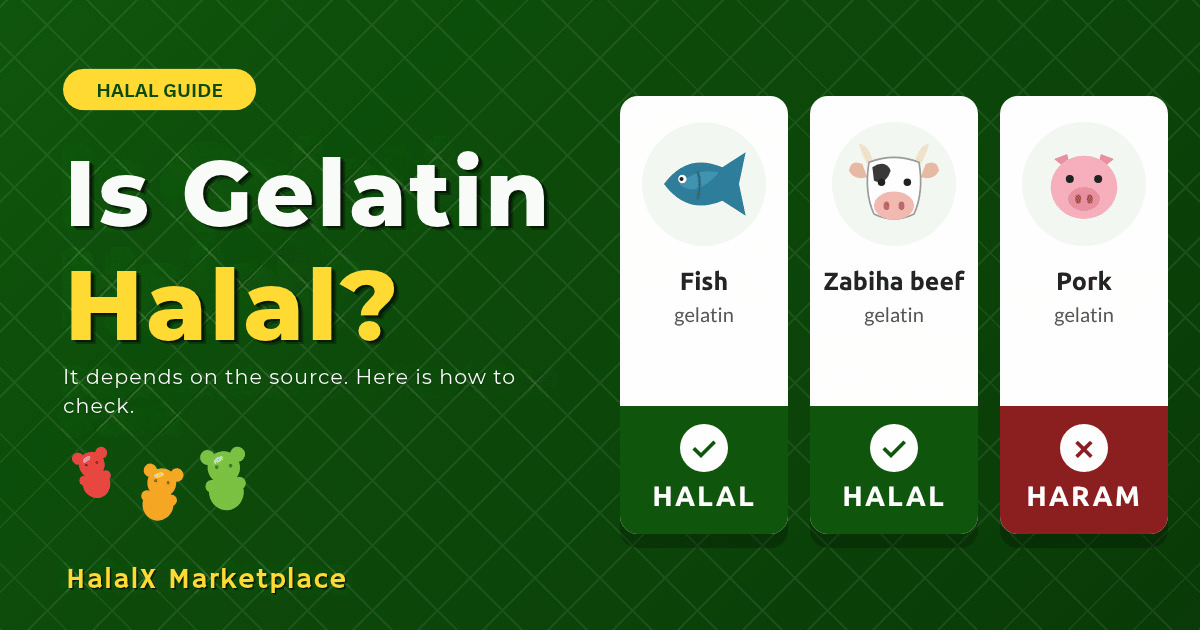
Quick answerIs gelatin halal? Only when it comes from a halal source. Gelatin from fish, or from cattle slaughtered the Islamic (zabiha) way, is halal. Gelatin from pigs is haram according to most scholars and US halal certifiers, and so is gelatin from cattle that were not slaughtered Islamically.[1][2] Plant-based gelling agents like pectin and agar are halal by default.[1]
Gelatin is in gummies, marshmallows, yogurt, desserts and many vitamin capsules. The problem is that a US label usually just says “gelatin.” It does not say which animal it came from. This guide gives the answer for each source, and shows you how to check a product in under a minute.
Is gelatin halal? Answer by source
The source decides the answer. Use this table as a quick guide:
| Gelatin source | Halal? | Why |
|---|---|---|
| Pork (porcine) | No | Pork is forbidden in the Quran. Most scholars and US certifiers say processing does not change that.[1][3] |
| Beef (bovine), zabiha | Yes | From a permissible animal slaughtered the Islamic way.[2][4] |
| Beef (bovine), not zabiha | No | Most certifiers require halal slaughter, even for cattle.[2][4] |
| Fish | Yes | Widely regarded as halal. Fish do not need ritual slaughter.[1] |
| Plant gelling agents (pectin, agar, carrageenan) | Yes | Not gelatin, but used in its place. Halal by default.[1] |
| Just “gelatin,” no source given | Unknown | Treat it as doubtful until you confirm the source. |
What is gelatin made from?
Gelatin is a protein made from animal collagen, taken from skin, hides and bones. GELITA, one of the world’s largest gelatin makers, says gelatin is “extracted from pigskins, bovine hides, and demineralized bones,” and can also come from chicken and fish.[5]
Pork is a very common source. IslamiCity’s Dear Hadi column notes that gelatin can come from cows and fish, but “the vast majority of gelatin used in the West comes from pigs.”[3] That is why the question “is gelatin halal?” matters so much for Muslim shoppers.
Is pork (porcine) gelatin allowed?
No. Most scholars and halal certifiers hold that gelatin from pigs is haram. The Quran forbids “the flesh of swine”:
“Forbidden to you is carrion, and blood, and the flesh of swine, and that over which any name other than God’s has been invoked…”
Quran 5:3
The American Halal Foundation, a US halal certifier, states that gelatin from pigs is “strictly haram… regardless of any purification processes.”[1]
Can processing make pork gelatin permissible?
This is the one point where scholars differ. It depends on istihalah, meaning a complete change of a substance into something new (wine turning into vinegar is the classic example).[3]
- Minority view: The Islamic Organization for Medical Sciences held that the change is complete, so the gelatin becomes pure.[6]
- Majority view: The Islamic Fiqh Council in Jeddah said gelatin from pork is not permissible when alternatives exist.[6] IslamiCity’s Dear Hadi explains that making gelatin does not involve “chemical recombination or essential alteration of its proteins,” so it is not a true istihalah.[3]
US halal certifiers follow the majority view. In practice, a halal-certified product will not contain pork gelatin.[1][2]
Is beef (bovine) gelatin allowed?
Beef gelatin is halal only if the cattle were slaughtered the Islamic (zabiha) way. Islamic Services of America (ISA), a US halal certifier, puts it simply: even when gelatin comes from cattle, “gelatin is not permissible unless the animal was slaughtered according to Zabiha Halal standards.”[2]
The Islamic Fiqh Council of the Muslim World League takes the same position. It permits gelatin from “permissible animals that have been slaughtered in the prescribed manner,” and not from pigs or other haram sources.[6]
So “bovine gelatin” or “beef gelatin” on a label is not enough. Most beef gelatin is made from ordinary, non-zabiha cattle. Look for a halal certification mark as well.
Can Muslims eat fish gelatin?
Yes. Fish gelatin is widely regarded as halal, and fish do not need ritual slaughter.[1] This follows the hadith about the sea: “Its water is pure and what dies in it is lawful food.”[7]
The one thing to watch is how the product was made. A factory that also handles pork gelatin can cause cross-contamination, which is why halal certifiers check production lines and batches, not just ingredients.[1]
Can Muslims eat kosher gelatin?
It depends on the source, so a kosher label alone is not enough. SeekersGuidance answers: “it depends on the source of the gelatin.” Kosher fish gelatin is halal. Gelatin from a pig or an unslaughtered animal is not.[8]
Today, OU Kosher says kosher gelatin comes from kosher-slaughtered cattle or kosher species of fish.[9] Kosher fish gelatin is the safest choice. For kosher beef gelatin, scholars differ on whether kosher slaughter meets halal rules, as we explain in our guide Halal vs kosher: what is the difference?
How to check a label: 5 steps
Under US rules, gelatin must be listed as an ingredient, but the label does not have to say which animal it came from.[10] So use these steps:
- 1Look for a halal certification mark. Check which organization issued it. US certifiers such as the American Halal Institute (AHI) visit the facility and review “the ingredients and handling of products” before issuing a certificate.[13]
- 2Read the ingredient list. “Fish gelatin” or “halal gelatin” is a good sign. Plain “gelatin” tells you nothing about the source.[1]
- 3Choose gelatin-free when you can. Pectin, agar and carrageenan do the same job and are halal by default.[1]
- 4Ask the brand or seller. If a product says halal, you can ask for the certificate or the gelatin source.
- 5When in doubt, leave it. The Prophet ﷺ said that “in between them there are doubtful (suspicious) things,” and that avoiding them protects your religion.[11]
New to halal rules? Start with our guide What is halal?
Gelatin in medicine and capsules
Many capsules and softgels are made of gelatin, so check them like food. Ask your pharmacist whether a plant-based capsule version is available.
If there is no alternative, Islamic law makes room for real need. The Quran says a person “driven by necessity – neither coveting it nor exceeding his immediate need” commits no sin.[12] IslamiCity’s Dear Hadi applies this to supplements: ask how necessary the supplement is and whether a reasonable alternative exists.[3] For a personal ruling, ask a qualified scholar you trust.
Halal gummies without the guesswork
The easiest halal gummy is one with no gelatin at all. Many gummies on HalalX Marketplace are gelatin-free, according to their product pages:
- Zaytun Halal Vitamin D3 Gummies are made with pectin instead of animal gelatin.
- Zaytun Halal Adult Multivitamin Gummies are made from vegan ingredients and certified halal by Islamic Services of America.
- Sakoon Black Seed Oil + Honey Gummies are labeled halal and gelatin-free.
See more in halal gummies and halal kids’ vitamins.
Common questions about gelatin
Is gelatin halal or haram?
It depends on the source. Gelatin from fish or zabiha-slaughtered cattle is halal. Gelatin from pigs, or from cattle not slaughtered Islamically, is haram according to most scholars and US certifiers.[1][2]
Can Muslims eat beef gelatin?
Only if the cattle were slaughtered according to zabiha halal standards. “Bovine” on the label is not enough on its own.[2]
Can Muslims eat fish gelatin?
Yes. Fish gelatin is widely regarded as halal by most Islamic scholars, as long as it is not cross-contaminated during production.[1]
Can Muslims eat kosher gelatin?
Not automatically. Kosher fish gelatin is halal. Kosher beef gelatin depends on whether you accept kosher slaughter as halal, and scholars differ on that.[8][9]
Can processing make pork gelatin permissible?
Most scholars say no, because making gelatin does not fully change the substance. A minority view says it does. US halal certifiers do not accept pork gelatin.[1][6]
Are gummies halal?
Only if the gelatin is from a halal source or the gummy uses pectin or agar instead. Look for a halal certification mark or a gelatin-free label.[1]
Shop halal gummies and vitamins on HalalX
HalalX Marketplace brings together independent halal and Muslim-owned brands in one place, with clear labels you can check.
Halal Gummies Vitamins & Supplements Halal CollagenQuran translation: Muhammad Asad, The Message of the Qur’an, via IslamiCity. This article is for general information. For a religious ruling on a specific product, consult a qualified scholar.
Sources
- American Halal Foundation, Gelatin guide: sources and certification (sources of halal gelatin, pork gelatin, fish gelatin, plant alternatives, certification).
- Islamic Services of America, Why Gelatin from Animal Sources Can Be Problematic for Halal Consumers (December 12, 2025).
- IslamiCity, Dear Hadi, Is pork gelatin in supplements ok? (June 10, 2025).
- Quran 5:3, IslamiCity.
- GELITA, What Is Gelatin?
- Islam Q&A, Fatwa 219137 on gelatin, citing the Islamic Fiqh Council (Muslim World League) and the Islamic Organization for Medical Sciences.
- Sunan Abi Dawud 83, IslamiCity Hadith. Graded sahih by Al-Albani, as listed on Sunnah.com.
- SeekersGuidance, Shaykh Faraz A. Khan, Answer on kosher gelatin
- OU Kosher, Gary Magder, Kosher Gelatin: Innovation and Tradition (August 14, 2023).
- FoodNavigator, Oscar Rousseau, Hindus have beef with US gelatin law (December 14, 2017); The Vegetarian Resource Group, Gelatin, Carmine and Rennet Labeling in the United States.
- Sahih al-Bukhari 52, IslamiCity Hadith.
- Quran 2:173, IslamiCity.
- American Halal Institute, Halal Certification (certification process: documentation, facility inspection, Sharia supervisor review).